Target Everest and Docomotion Unite to Transform Discovery Hotels’ Document Generation Through Powerful Salesforce Integration

 Target Everest |
 In the competitive hospitality industry, maintaining seamless customer experience while efficiently managing operations is crucial. Discovery Hotel Management faced this challenge head-on when they decided to modernize their operations with a comprehensive Salesforce CRM solution. Through the strategic partnership of Target Everest and Docomotion, they achieved a complete digital transformation that streamlined their operations and enhanced customer experience.
Discovery Hotel Management needed to unify customer data across multiple properties while streamlining their document generation processes. They sought a solution that would maintain brand consistency in all communications and integrate various business processes into a single platform.
Target Everest stepped in with a tailored Salesforce implementation that transformed their operations. The solution unified customer data, streamlined sales processes, and enhanced reporting capabilities, all while ensuring seamless integration with existing systems. To complete this comprehensive solution, Target Everest selected Docomotion as their document generation partner, recognizing its Salesforce integration, intuitive template designer, and advanced document automation capabilities as key factors in meeting Discovery Hotel Management’s needs.
“Our Salesforce implementation expertise, combined with Docomotion’s document generation capabilities, created a powerful solution that perfectly aligned with Discovery Hotel Management’s luxury brand standards.” notes Target Everest’s project lead, João Carvalho . “The seamless integration of both platforms demonstrates our ability to deliver comprehensive CRM solutions that transform business operations.“
“While this marks our first project together, we see Target Everest as an important strategic partner for Docomotion.” says Guy Lifshitz, Alliance Director at Docomotion. “Their global presence aligns perfectly with our expansion goals. The success of this implementation demonstrates the potential of our partnership to deliver exceptional solutions across various markets.“
The results of this partnership were immediate and significant. Document generation time plummeted from 5 minutes to 30 seconds, ensuring rapid and consistent output across all properties. The automation of document creation not only maintained brand integrity but also facilitated streamlined approval processes, boosting overall productivity. Staff could now devote more time to enhancing guest experiences rather than administrative tasks.
The successful collaboration between Target Everest and Docomotion has created a blueprint for hospitality industry digital transformation. By combining Target Everest’s deep understanding of Salesforce implementation with Docomotion’s advanced document generation capabilities, Discovery Hotel Management received a solution that not only met their immediate needs but positioned them for future growth. This implementation showcases how strategic technology partnerships can deliver comprehensive solutions that drive business success while maintaining brand excellence.
The transformation at Discovery Hotel Management stands as a testament to the power of choosing the right technology partners. The solution demonstrates how expert Salesforce implementors like Target Everest, combined with Docomotion’s advanced document generation technology, can deliver end-to-end CRM solutions that drive digital transformation in the hospitality sector. This partnership exemplifies how hospitality businesses can achieve operational excellence while maintaining brand consistency through cutting-edge technology and industry expertise.
For more information, please contact us through the form.
Explore more articles on our blog!
Managing B2B Relationships with Salesforce Marketing Cloud Account Engagement
 Target Everest |
 Salesforce Marketing Cloud Account Engagement (MCAE, formerly known as Pardot) is a native Salesforce CRM platform that offers B2B-focused marketing solutions. This platform helps companies manage relationships with leads and customers through its robust tools, such as Lead Scoring and Grading, personalised journeys, automations, and more, helping to nurture, re-engage, and strengthen customer loyalty.
MCAE supports marketing teams in qualifying, nurturing, and aligning their strategies, personalising communications, and automating workflows.
Synchronisation with Salesforce CRM Leads and Contacts
The full integration with Salesforce CRM enables the automatic synchronisation of qualified Leads and Contacts with the CRM. This ensures that both marketing and sales teams have up-to-date, synchronised information about each individual, allowing them to invest in new strategies.
Companies can prioritise marketing efforts by developing campaigns and strategies focused on lead qualification. Once qualified, leads are then passed on to the sales team to begin the sales process. This alignment enables both teams to collaborate effectively, ensuring successful sales outcomes and fostering long-term relationships with customers, promoting loyalty after conversion.
Lead Nurturing
The creation of personalised journeys allows for the development of highly segmented lead nurturing strategies, delivering relevant content at every stage of the customer journey, thus increasing the chances of conversion. Within these journeys, various actions can be configured, such as email sending, field updates, task creation in Salesforce CRM, and more. Additionally, dynamic paths can be built based on specific criteria, such as certain lead fields or whether the customer has opened the email.
Lead Scoring and Grading
These two tools support marketing strategies by enabling precise lead qualification. They allow companies to evaluate a customer’s level of interest in the business and determine whether the lead profile aligns with what the company considers most valuable. This facilitates the transfer of highly qualified leads to the sales team, optimising time and effort.
Lead Scoring measures a lead’s interest level by evaluating interactions such as website visits, form completions, or content downloads. This tool helps prioritise the most engaged leads, allowing for the creation of segmented journeys and enabling the sales team to focus on leads with the highest scores.
Lead Grading evaluates the lead’s profile against the ideal customer criteria. For example, a company operating exclusively in Portugal would assign a higher grade to leads from Portugal compared to those from other countries. This way, the company can prioritise leads not only based on engagement but also on alignment with the ideal customer profile.
Reports and Performance Analysis
Salesforce Marketing Cloud Account Engagement offers valuable reports, such as the Prospect Lifecycle. This report details the entire journey of the prospect, from their first interaction with the company, through conversion and qualification, to becoming a sales opportunity. It also provides insights into the number of successful deals and the revenue generated from these conversions.
Another important report is campaign analysis, which allows the tracking of campaign effectiveness by measuring KPIs such as conversion rate, opportunities generated, and campaign ROI.
One of the key benefits of Salesforce integration is the ability to gain a comprehensive view of the customer journey, from the first contact to the final sale, making it easier to analyse the customer lifecycle.
B2B Marketing Automation
B2B campaign automations reduce manual work by sending personalised communications automatically, based on lead interactions or changes to specific fields.
Automations allow for the configuration of various actions to be triggered at the right time and for the right person, ensuring the relevance of the content, and on a large scale.
Advanced Segmentation
MCAE enables the creation of highly segmented B2B audiences based on demographic, geographic, and behavioural data. Static or dynamic audiences can be defined, ensuring that information is only sent to the right people, maintaining the relevance of communication.
A well-structured segmentation strategy has a significant impact on the lead lifecycle, accelerating sales and connecting marketing and sales teams with the right leads at the right time.
Effective B2B Relationship Management
Effective B2B relationship management with Salesforce Marketing Cloud Account Engagement is essential for maximising lead interaction and conversion potential. The synchronisation of leads and contacts with Salesforce CRM ensures that all relevant information is centralised, providing a complete view of the customer or prospect.
Lead nurturing enables the building of stronger, more personalised relationships, with targeted messaging throughout the customer journey. Automations optimise processes, facilitating the creation of highly personalised campaigns, while reports offer performance analysis and valuable insights.
Together, these integrated tools provide efficient management, enhancing B2B relationships and driving commercial results.
Interested in learning more about Salesforce Marketing Cloud Account Engagement? Fill out the form, and we’ll get in touch with you soon.
Explore more articles on our blog!
Top 10 Salesforce Features You Need to Know
 Target Everest |
 Salesforce is a customer relationship management platform that helps businesses manage sales, customer service, support, marketing, among other things. Salesforce features enable data centralisation, process automation, and offers metrics that help improve business efficiency and personalisation in customer service.
Here are the top 10 Salesforce features you need to know to help boost your business:
Account and Contact Management
Salesforce helps store detailed information about customers and contacts, including interaction and communication history. With data centralisation, all customer information, including history, is kept in one place, making the team more efficient, as they have accessible and organised data, helping with quicker decision-making. It also helps with customer segmentation, where data makes it possible to personalise interactions based on each customer’s history.
Sales Opportunities
With Sales Opportunities, it is possible to track and manage the progress of potential sales from the beginning to the closing stage. This allows for a clearer and more detailed view of the sales pipeline.
Lead Management (Intelligence View)
With lead management, it is possible to track, manage, and qualify leads, improving efficiency in converting prospects into customers. This enables more efficient lead qualification, helping to identify and qualify leads with the highest conversion potential. Additionally, communications and activities carried out by the sales team with the leads are monitored, ensuring a more consistent follow-up, thus improving the conversion process by prioritising the most promising leads.
Sales Forecasting
This Salesforce feature is excellent for predicting future revenues based on opportunity data and sales history. These projections help estimate future revenues, enabling managers to plan strategies based on reliable forecasts, as well as allowing for quick adjustments to goals and strategies, thanks to real-time updates.
Territory Management
Territory management facilitates the organisation and division of the sales team into geographical territories. It helps distribute opportunities and accounts to the most suitable teams or sales representatives based on geographical criteria, account volume, or other factors.
Configure, Price, and Quote (CPQ)
A feature for quickly creating accurate and personalised quotes, including prices, discounts, and different quote templates. This feature helps automate product configuration, price setting, and faster, more accurate proposal generation, eliminating manual errors. It also simplifies complex products or multiple options, making it easier for teams to select options and combinations according to business needs.
Email Integration (Einstein Activity Capture)
Email integration with Einstein Activity Capture allows for the synchronisation of emails and calendars with Outlook and Gmail, enabling the tracking of sales communications. This improves visibility of customer interactions, increasing the efficiency and collaboration of teams.
Collaboration and Chatter
This Salesforce feature enables real-time communication between teams. It is a kind of integrated corporate social network that allows team members to collaborate with one another, facilitating the flow of information, sharing updates, and centralising relevant conversations within the CRM.
Opportunity Pipeline Inspector
This feature offers sales teams a consolidated view of pipeline metrics, opportunities, weekly changes, AI-based insights, forecasted close dates, etc. It highlights recent changes, such as new values, delayed closings, or changes in sales stages. This makes the sales process more efficient and data-driven.
Artificial Intelligence (Einstein Predictive AI)
Salesforce’s Artificial Intelligence uses machine learning to provide predictions and automated insights based on CRM data. AI features provide forecasts, recommendations, and insights to optimise sales processes.
These and other comprehensive Salesforce features support sales and support management, from centralising detailed and historical data for each customer to using AI to assist in forecasts and sales management. Don’t forget to explore the powerful Dashboards and Reports, which provide real-time insights to drive smarter business decisions.
Interested in learning more about these and other Salesforce features? Complete the form, and we’ll get in touch with you soon
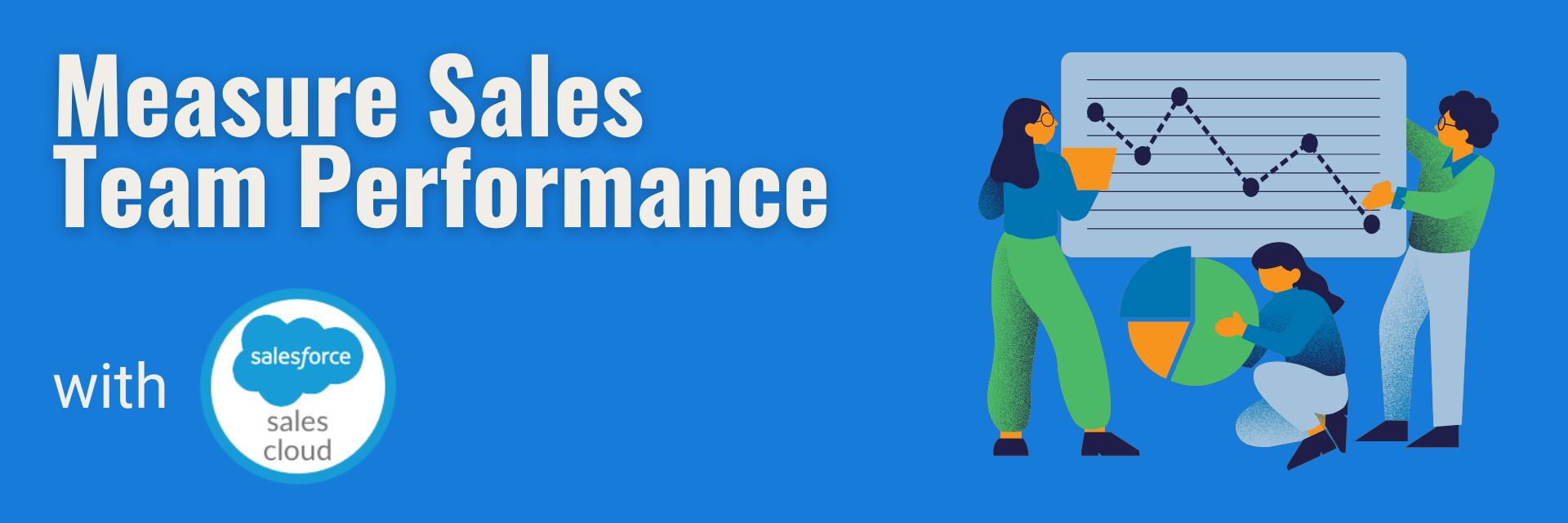
Salesforce Reports and Dashboards: How to Measure Sales Team Performance in Sales Cloud
 Target Everest |
 In today’s competitive business world, having accurate and up-to-date data is essential for making strategic decisions and optimising processes. This is where Salesforce Reports and Dashboards shine, offering sales teams indispensable tools for tracking performance.
By providing a clear, comprehensive view of team performance, these features enable managers to identify opportunities, detect issues, and swiftly implement solutions.
Real-Time Tracking
One of the most significant benefits of Salesforce Reports and Dashboards is the ability to monitor sales team performance in real-time. Imagine having a dashboard that displays the number of opportunities in the pipeline, conversion rates, and revenue generated at any given moment. With this instant visibility, managers can quickly identify areas requiring attention and make strategic decisions to boost results. For instance, if conversion rates are below target, adjustments to sales strategies, additional team support, or revisiting lead profiles can be implemented without delay.
Sales KPIs
Measuring team performance effectively starts with defining and tracking the right KPIs (Key Performance Indicators). Some of the most critical KPIs include:
- Conversion Rate: The percentage of opportunities that result in sales.
- Revenue Generated: Total sales achieved over a specific period.
- Sales Pipeline: The current stage of each opportunity within the sales funnel.
- Sales Cycle: The average time from the first lead interaction to closing the sale.
- Number of Opportunities Created: Reflects the team’s ability to generate new leads.
By monitoring these KPIs, managers can identify trends, compare individual performance, and make more informed decisions to optimise outcomes.
Key Reports in Sales Cloud
Salesforce offers a variety of reports to provide valuable insights into sales team performance. Let’s explore some of the most essential:
- Opportunities by Stage Report This report is essential for tracking sales progress. By breaking down opportunities by stage (prospecting, negotiating, closing), it becomes easy to pinpoint where deals are being lost, helping to fine-tune strategies and increase conversion rates.
- Sales Performance Report Want to know who your top performers are? This report compares sales targets against actual results, enabling managers to reward top performers and identify those needing additional support.
- Lead Conversion Rate Report Tracking your lead conversion rate helps assess the success of marketing campaigns. By monitoring this metric, you can evaluate lead quality and the effectiveness of qualification strategies.
- Sales Activity Report A detailed breakdown of sales activities, such as calls, emails, and meetings, ensures the team is focused on high-priority tasks, and helps improve time management.
- Forecast Report Sales forecasting is crucial for financial planning. By estimating potential revenue based on active pipeline opportunities, managers can make more informed decisions about investments, resource allocation, and sales goals.
Custom Dashboards
Have you ever imagined having a panoramic view of your sales team’s performance in real-time, tailored to your business needs? With Salesforce’s custom dashboards, you can achieve just that! Dashboards visually present key metrics such as:
- Opportunities: How many are open, their stage in the pipeline, and the expected value?
- Sales: Who are the top performers? Which products are selling the most?
- Leads: How many were generated? What’s the conversion rate?
- Forecasts: What revenue can be expected in the upcoming months?
Lead Quality Metrics
Generating leads is just one piece of the puzzle. With Salesforce lead quality reports, you can:
- Assess Lead Quality: Determine which leads have the highest potential for conversion.
- Focus on What Matters: Direct efforts towards the most promising leads.
- Refine Campaigns: Understand which campaigns generate higher-quality leads.
Metrics like lead conversion rate help businesses refine both marketing and sales strategies. By keeping a close eye on these metrics, you can optimise your processes and improve your chances of closing deals.
Pipeline Analysis
Your sales pipeline is the backbone of your business. Tracking all opportunities from the first contact to close is essential, and regular pipeline analysis ensures you’re maximising potential. Reports and dashboards help monitor the health of your pipeline at various stages, allowing you to identify deals close to closing and those needing extra attention.
Sales Cycle Analysis is also crucial. By measuring the average sales cycle and how it varies depending on the client or opportunity type, you can identify bottlenecks and refine your approach.
Automation and Proactive Insights
Imagine no longer having to generate reports manually… With Salesforce’s automation features, you can schedule reports to be sent automatically to managers at regular intervals. This keeps everyone informed of the team’s performance without needing to request additional reports.
With Salesforce Einstein Analytics, you gain deep insights into your sales team’s performance. This AI-driven tool identifies patterns, trends, and growth opportunities that may otherwise go unnoticed.
Data-Driven Adjustments
Data-driven decision-making is key to success in sales. Using Salesforce Reports and Dashboards allows sales teams to:
- Identify Trends: Observe patterns in data to uncover opportunities and challenges.
- Take Corrective Action: Make swift, effective decisions to resolve issues and optimise processes.
- Customise Approaches: Tailor sales strategies for each customer or market segment.
- Continuous Improvement: Use data to measure the impact of changes and make ongoing adjustments.
In conclusion, Salesforce Reports and Dashboards in Sales Cloud are powerful tools that transform data into actionable insights. By offering a clear, real-time view of sales team performance, managers can make smarter decisions, optimise processes, and more effectively reach business goals.
Check out more posts on our blog!
If you want to learn more about Salesforce Sales Cloud, complete the form and we’ll get in touch with you soon!
How Service Cloud enhances Customer Satisfaction with proactive solutions
 Target Everest |
 Salesforce’s Service Cloud has transformed the way businesses interact with their customers, offering a unified, efficient, and personalised support platform. By centralising communication channels, Service Cloud provides a streamlined service that boosts customer satisfaction.
What truly sets Service Cloud apart is its ability to shift from reactive to proactive customer service. By anticipating customer needs, companies can solve problems before they arise, resulting in significantly higher levels of customer satisfaction.
Automated Support: Chatbots and AI
Service Cloud leverages AI and chatbots to elevate customer support. By automating responses to frequently asked questions and resolving simple issues, chatbots provide round-the-clock assistance, delivering fast and efficient solutions. This automation not only reduces human agent workload but also speeds up problem resolution, increasing customer satisfaction by providing instant answers.
Additionally, AI identifies patterns in interactions, enabling chatbots to continuously learn and adapt, making responses increasingly accurate and personalised.
Automation of repetitive tasks, such as case creation or record updates, also optimises workflows. This allows agents to focus on more complex, personalised customer interactions, improving team efficiency and reducing response times. Such an amazing advantage, right?
360º Customer View
Service Cloud revolutionises how companies manage customer information. By centralising contact details, interaction history, purchase data, and preferences on one platform, agents gain a comprehensive view of each customer. This eliminates the need for multiple systems, streamlining support and ensuring agents have the information required for effective assistance.
A complete view of customer history allows agents to offer personalised solutions, pre-empting problems, and suggesting tailored products or services, fostering long-lasting relationships and increasing loyalty.
Proactive Solutions
With AI and machine learning, Service Cloud goes beyond reacting to issues, enabling businesses to anticipate and resolve potential problems before they impact customers. By analysing historical data and behaviour patterns, the platform identifies warning signs, allowing companies to take preventative measures.
It also enables businesses to send personalised alerts, notifying customers of updates or resolving issues before they even reach out. This proactive approach builds trust and reinforces the company’s commitment to exceptional service.
Omnichannel and Real-Time Support
Omnichannel integration within Service Cloud consolidates phone, chat, email, and social media into a single platform, delivering a seamless, personalised experience across all channels. This allows agents to access the full history of customer interactions, improving resolution efficiency.
With real-time support and personalised responses, customer satisfaction and loyalty grow. Automated workflows also ensure that each customer is directed to the right specialist, optimising response times and service quality. You save a lot of time, don’t you think?
Knowledge Base
Salesforce Service Cloud empowers customers to resolve common issues autonomously through a comprehensive knowledge base. This self-service tool, filled with articles, FAQs, and tutorials, helps customers find quick solutions, reducing the need for agent interaction.
By providing customers with the ability to solve problems themselves, businesses can optimise resources while increasing customer satisfaction through a fast, efficient, and empowering support system.
Agent Support
Powered by AI, Service Cloud also significantly enhances agent support. Advanced algorithms analyse interactions in real-time and suggest optimal actions for each situation.
Complex cases often require collaboration between departments, and Service Cloud facilitates this through real-time tools such as chat and video conferencing. Agents can share information, discuss solutions, and escalate issues quickly, reducing resolution times and boosting customer satisfaction.
Metrics and Feedback
Service Cloud provides a robust suite of tools to measure and analyse customer support performance. Metrics such as Net Promoter Score (NPS) and Customer Satisfaction Score (CSAT) are integrated into the platform, allowing businesses to closely monitor customer satisfaction and pinpoint areas for improvement.
Real-time feedback collection further ensures service excellence, helping companies stay responsive to customer needs.
In conclusion, in today’s customer-centric world, Service Cloud provides businesses with a competitive edge by unifying service operations and automating key processes. Features like Omni-Channel Routing, Case Management, and Knowledge Base make Service Cloud an all-encompassing solution that enhances customer service, optimises resources, and drives loyalty.
By investing in Service Cloud, businesses can transform customer service into a strategic advantage, increasing satisfaction and loyalty while boosting operational efficiency.
Check out more posts on our blog!
Interested in learning more about Salesforce Service Cloud? Complete the form, and we’ll get in touch! with you soon.
Personalising the Customer Journey with Marketing Cloud Engagement
 Target Everest |
 Salesforce Marketing Cloud is Salesforce’s B2C-focused tool that helps businesses deliver relevant campaigns and personalised content to each customer, while also supporting the development of customer journeys. Personalisation in marketing is essential to creating content that aligns with the profile and expectations of each customer. By leveraging online behaviour and even purchase history, companies can segment their audiences and create personalised experiences across various touchpoints, from awareness to loyalty. With the different Studios and Builders in Salesforce Marketing Cloud, it’s possible to create unique and innovative experiences, and even use artificial intelligence to enhance content and journey personalisation by predicting needs and adjusting communication to what is most convenient for each individual.
The Importance of Personalisation
Even though customers may like the same product or service category, each one has different tastes and needs. Personalising the experience helps increase engagement with a company’s content and even promote a closer relationship with the customer by delivering messages and offers tailored to their needs and interests.
Personalisation ensures a more genuine and unique experience because a customer with specific tastes and behaviours can build a relationship of trust with a company that knows them and delivers exactly what they need. Imagine a customer from a children’s store who bought a size 20 pair of shoes for their child, receiving an email six months later with special offers for size 21? It may seem simple, but knowing that the company understands them and their family, and even knows their child’s current shoe size, could be a significant advantage, don’t you think?
Intelligent Segmentation
For intelligent segmentation, it’s important to build detailed and targeted profiles to send specific messages in the Customer Journeys.
It’s essential not only to personalise the customer experience at each touchpoint, from awareness to loyalty, but also to create intelligent segmentation to build effective and personalised campaigns that make sense in crafting the overall experience.
How to achieve intelligent segmentation?
It is possible to create segmentations based on demographic, geographic, and even behavioural data, such as customers who have purchased in the last six months, customers who haven’t purchased in the last three months, regular customers, and those needing re-engagement, allowing for the sending of personalised customer journeys and improving the precision of content.
Using Data and Content for Personalisation
With Salesforce Marketing Cloud, it’s possible to gather data through forms and surveys and even collect real-time data on online behaviour and purchase history. An online store could send personalised content to someone who had a negative experience with a product or service (giving it a low rating), expressing that their opinion is valued, their points of view will be reviewed, and perhaps even offering a discount on another product or service to demonstrate that not all experiences are negative and to seek their trust again. Or they could create an Abandoned Cart Journey, reminding the customer of the items left in the cart and that they still have time to complete the purchase. What an amazing customer Journey, don’t you think?
The more data a company has about a customer, the more personalised the content can become, and the stronger the connection with the customer will be. Within a single email, hundreds of different experiences could be offered, each tailored to the individual desires and needs of the customers, speaking directly to each one.
Another important consideration is the use of A/B testing, as this tool allows companies to test different personalisation approaches and identify which one generates the most engagement and conversion.
Marketing Automation and Omnichannel in Customer Journeys
The Journey Builder is a powerful tool within Marketing Cloud. It allows personalised content to be sent at scale while still targeting distinct profiles and behaviours. With Journey Builder, it’s possible to send messages at the right moment for each customer, using AI tools, for example, to deliver the message at the best time for each individual, based on their behaviour. A single journey working for each individual. Amazing!
The customer experience can be delivered across multiple channels in the Customer Journey (Email, SMS, WhatsApp, etc.) while still respecting each individual’s preferences. The key is to maintain a consistent narrative across all the touchpoints where the customer interacts.
Salesforce Marketing Cloud is a highly powerful tool for attracting, retaining, and keeping customers close to a company. By personalising content, it’s possible to reach audiences with varied tastes and behaviours, offering them exactly what they need at the right moment. Additionally, with automated journeys working for the company, it will have happy and satisfied customers while the platform works autonomously, driving more engagement and results.
Interested in learning more about Salesforce Marketing Cloud? Complete the form, and we’ll get in touch with you soon
Innovations and Key Trends at Dreamforce 2024
 Target Everest |
 Dreamforce 2024, held from September 17-19 in San Francisco, was the world’s largest AI event, showcasing innovations like Agentforce, the first platform for building autonomous agents. Attendees enjoyed transformative keynotes, groundbreaking product launches, and hands-on learning sessions.
In today’s blog post, we dive into the firsthand experience of our Managing Partner, Alexandre Bento, at Dreamforce 2024. Through his insights, discover the latest innovations and key trends from the world’s largest AI-focused event.
Alexandre, what were the main trends highlighted at Dreamforce 2024?
Dreamforce 2024 was truly a pivotal event, with two major trends standing out: Agentforce and Data Cloud. Agentforce represents a significant leap in AI technology, introducing autonomous agents capable of handling complex tasks independently. These agents, evolving from the “Copilot” model, are now able to make decisions and execute actions based on real-time data within Salesforce, offering seamless AI integration into business processes. This allows businesses to automate operations more efficiently while maintaining accuracy and speed in decision-making.
Data Cloud plays a crucial role in supporting this transformation, providing real-time data that powers these AI agents, enabling personalisation and improving operational efficiency. This advancement allows businesses to make informed, agile decisions, transforming how they leverage data across the enterprise.
Additionally, Tableau Einstein was a standout innovation this year. This next-generation analytics platform combines the power of Tableau with AI, providing predictive and contextual insights directly within workflows. Integrated with Salesforce, it enables businesses to make strategic decisions faster and more effectively. These innovations show that AI and data analytics are becoming deeply embedded in daily operations, elevating automation and personalisation to new heights.
Which keynote or session was the most impactful for you and why?
The Main Keynote was the most impactful for me, especially because of the Agentforce announcement and the live demo. Seeing a real-world application of AI-powered agents in action was a game-changer, showcasing how these tools can revolutionise business processes through automation and data-driven decision-making.
What insights did you gain from the keynote speakers or Salesforce leaders?
One of the key takeaways from the Salesforce leaders was the emphasis on how fast the business landscape is changing, especially in how customers interact with services. Agentforce will play a pivotal role in reshaping customer engagement through automation, making these interactions faster, smarter, and more efficient.
Did you see any new Salesforce features or innovations that caught your attention?
Yes, without a doubt, Agentforce was the highlight. It’s pushing business automation to the next level, allowing AI agents to autonomously handle tasks like customer service inquiries and sales lead qualification. This kind of innovation can significantly streamline operations for businesses.
How could these innovations impact Target Everest’s clients?
Agentforce could have a massive impact on our clients by fully automating their customer support journeys. By implementing these AI agents, we can help our clients provide faster, more efficient service, reducing the need for manual intervention and improving overall customer satisfaction.
Did you participate in any technical sessions or workshops? How was the experience?
Yes, I took part in several hands-on sessions focused on Agentforce and Data Cloud. These sessions were incredibly valuable for deepening my knowledge of these products. It’s a great opportunity to gain insights, learn new skills, and get a first-hand look at the tools before they’re fully available to the broader community. Plus, the exclusive Salesforce swag was a nice bonus!
Did you learn anything new that we can apply to our projects?
Definitely! Once available, we can apply the Agentforce Service Agent to automate customer support processes for our clients. This will greatly improve efficiency and enhance the customer experience, allowing businesses to operate more smoothly.
How do the discussions at Dreamforce reflect upcoming market trends?
The discussions at Dreamforce clearly show that Salesforce is deeply attuned to its customers’ evolving needs. Salesforce is a customer-centric company, and the innovations they are introducing—like Agentforce—are directly aligned with what customers are seeking: more personalised, efficient, and data-driven customer experiences.
Any insights on the future of CRM and digital transformation that our clients should know?
The biggest realisation from Dreamforce is that the future of customer engagement and interaction will rely heavily on text, voice, and visual inputs. Businesses need to adapt to this new reality quickly by upgrading their digital systems to support these interaction methods. Otherwise, they risk becoming outdated and irrelevant.
What was your overall experience in terms of learning and inspiration at the event?
Dreamforce was the best event I’ve ever attended. It offered a wealth of well-curated content, training, workshops, and a showcase of cutting-edge innovations. The level of learning and inspiration was truly unmatched.
Was there anything memorable or unexpected that you’d like to share?
Yes, one memorable moment was that I was so engaged in the sessions that I completed and passed two Salesforce certifications in a single afternoon! It was a great achievement and a testament to how immersive and motivating the event was.
Want to know how Target Everest can apply these innovations to your business? Complete the form, and we’ll get in touch with you soon!
Target Everest Partnership with Vera Solutions for Amp Impact on Salesforce
 Target Everest |
 LISBON, PORTUGAL | LONDON, UNITED KINGDOM, July 25th, 2024 — Target Everest is delighted to announce a new partnership with Vera Solutions, a social enterprise and Certified B Corporation. This collaboration is set to empower nonprofit organizations by providing them with strategic solutions that enhance operational efficiency and generate impactful insights, all through the Amp Impact on Salesforce.
Empowering Nonprofits with Amp Impact on Salesforce
Amp Impact empowers nonprofit organizations to replace complex spreadsheets with a flexible, friendly, and integrated technology solution built on the Salesforce platform. As an Amp Impact implementation partner, we will support clients from initial implementation and integration to training and support services.

“At Target Everest, we believe that even small contributions can make a difference. We are happy to announce our partnership with Vera Solutions around Amp Impact, one of the leading cloud-based solutions for grant management and impact measurement. This collaboration enhances our ability to support non-profit organizations by leveraging Salesforce technology to drive impact in the social sector. Together, we aim to create positive change and make a meaningful contribution to improving the world.”
– Alexandre Bento, Co-Founder and Managing
Partner at Target Everest
Together, Target Everest and Vera Solutions are dedicated to providing organizations with the capabilities to become more efficient in grant management, program management, and impact measurement through Amp Impact on Salesforce.
“We’re happy to announce the expansion of our partner program with Target Everest, a Salesforce Consulting Partner with experience delivering solutions for the past 10 years. We look forward to seeing Amp Impact and Target Everest’s consulting team help more nonprofit organizations create meaningful outcomes.”
– Zak Kaufman, Co-Founder and CEO at Vera Solutions.
About Vera Solutions
Vera Solutions is a 5-time Certified B Corporation driven to amplify the impact of the social sector by providing cloud-based solutions for organizations to manage portfolios and programs, deliver projects, optimize grant management, and measure impact. By building on the Salesforce platform, Vera provides flexible, scalable solutions that enable organizations to become more transparent, accountable, and effective. Over $12 billions of programs, grants, and projects advancing the UN Sustainable Development Goals are managed using Vera’s flagship product, Amp Impact.
Having served over 420 nonprofits, foundations, impact investors, social enterprises, UN agencies, and multilateral organizations, Vera’s team has extensive knowledge of the nonprofit sector and deep experience in delivering the right solutions for many organizations.
To learn more about Vera Solutions, please visit https://www.verasolutions.org/.
About Target Everest
Target Everest is a digital consulting organization specialising in Salesforce solutions. With offices in Slovakia, Portugal, and India, we are dedicated to helping businesses maximize their potential through tailored Salesforce implementations and customizations. Target Everest offers a range of services, including Salesforce integration, support, training, and advisory services.
We work closely with non-profit organizations and other entities to enhance our capabilities and effectiveness. At the core of our operations are the values of integrity, commitment, and excellence, which guide us in building lasting relationships based on trust and transparency. Our team of experienced professionals is dedicated to delivering exceptional service and ensuring our clients’ success through the effective use of Salesforce solutions.
Salesforce Email-to-Case Tutorial
 Target Everest |
 What is Email-to-Case?
- Email-to-Case helps automate customer support by converting received emails from customers into cases and auto-populating fields for quick resolution. Email-to-Case on-demand service manages email traffic outside the network’s firewall and limits messages to 25 MB.
Email-to-Case Key Features and Benefits
- Seamless association of customer responses with original cases, including attachments, streamlining case management.
- Comprehensive case reporting tracks both inbound and outbound emails, providing insights into issue resolution processes.
- Flexible routing addresses enable the creation of multiple email addresses for converting customer emails into case fields.
- Integration with Assignment Rules, Escalation Rules, Workflow Rules, and Auto-Response Rules ensures smooth operation and enhanced efficiency.
Setup Email to Case in Salesforce with Microsoft 365
Before anything we have to set a couple policies in Microsoft 365 Admin
- Open the Microsoft Admin
- In Admin Centers Tab, go to Security
- In Email & collaboration tab, go to Policies & rules
- Here go to Threat policies
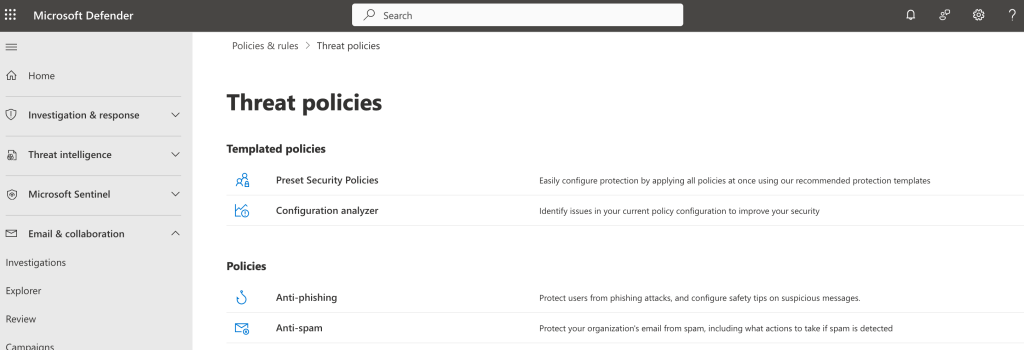
- Then Anti-spam policies
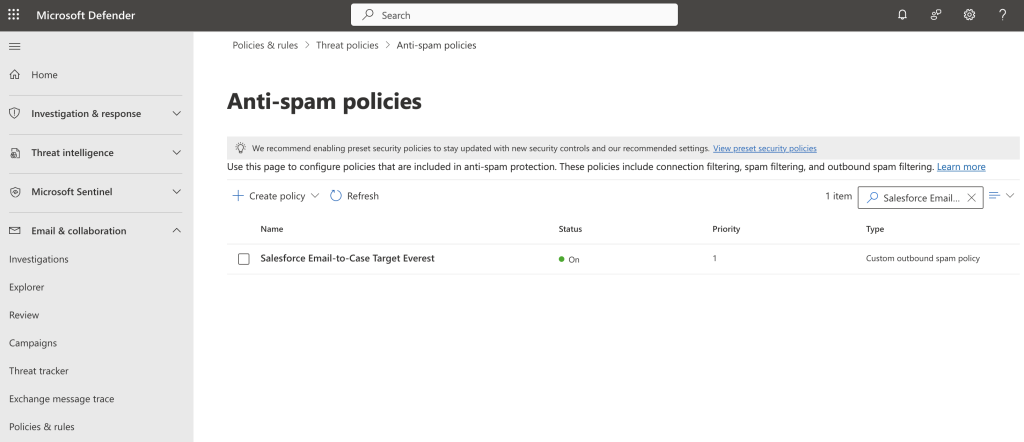
- In here click Create policy > Outbound
- Follow these Steps during Policy creation
- Set policy name accordingly
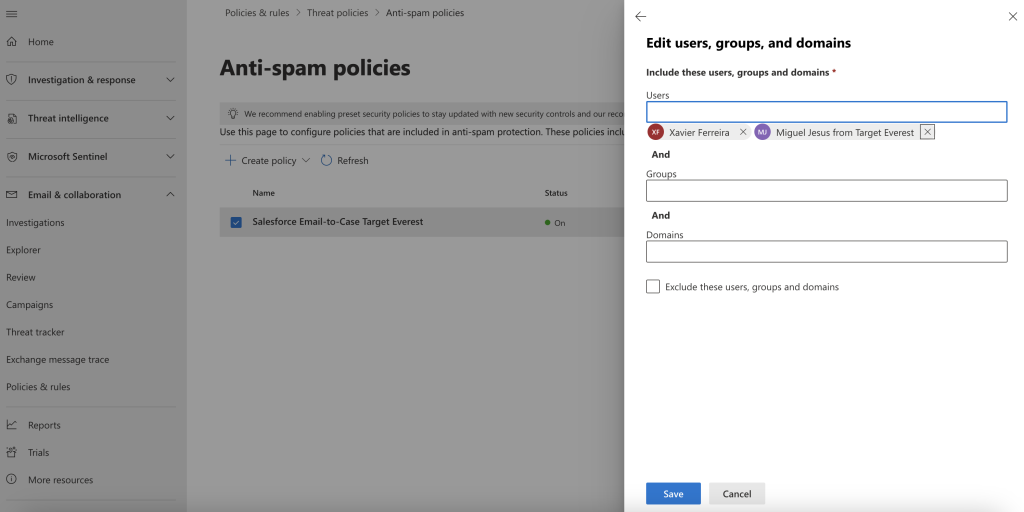
- Set user, group or domain to include on this policy
- On the Outbound Protection Settings, set the Automatic Forwarding Rules to “On – Forwarding is enabled
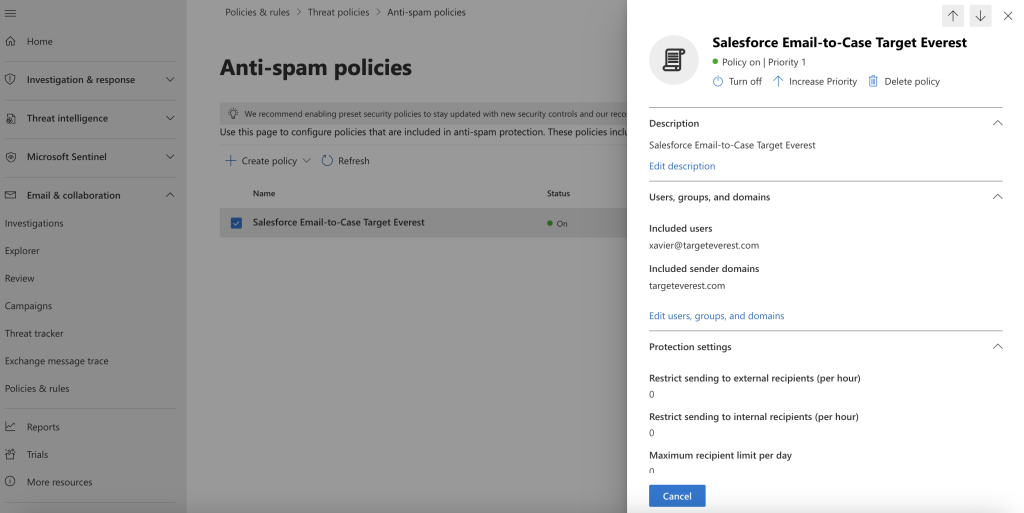
And we are done here!
Back to your Salesforce Environment
1. The first step is to enable Email-to-Case in Salesforce
- Go to Setup
- In “Quick find”, search and open “Email-to-Case” and click on the “Edit” Button
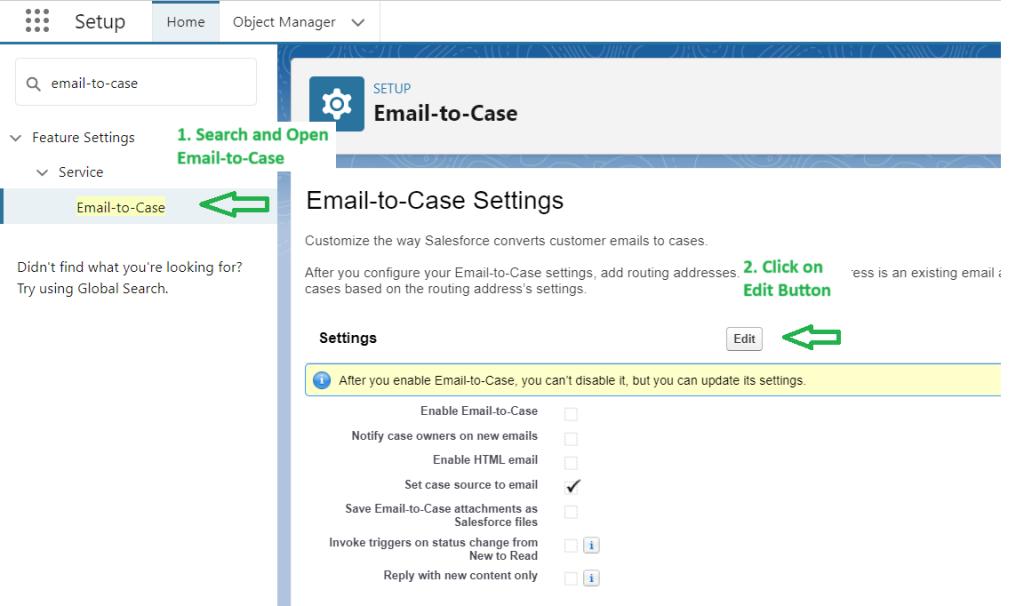
- Select “Enable Email-To-Case” and “On-Demand Service” then click on Save.
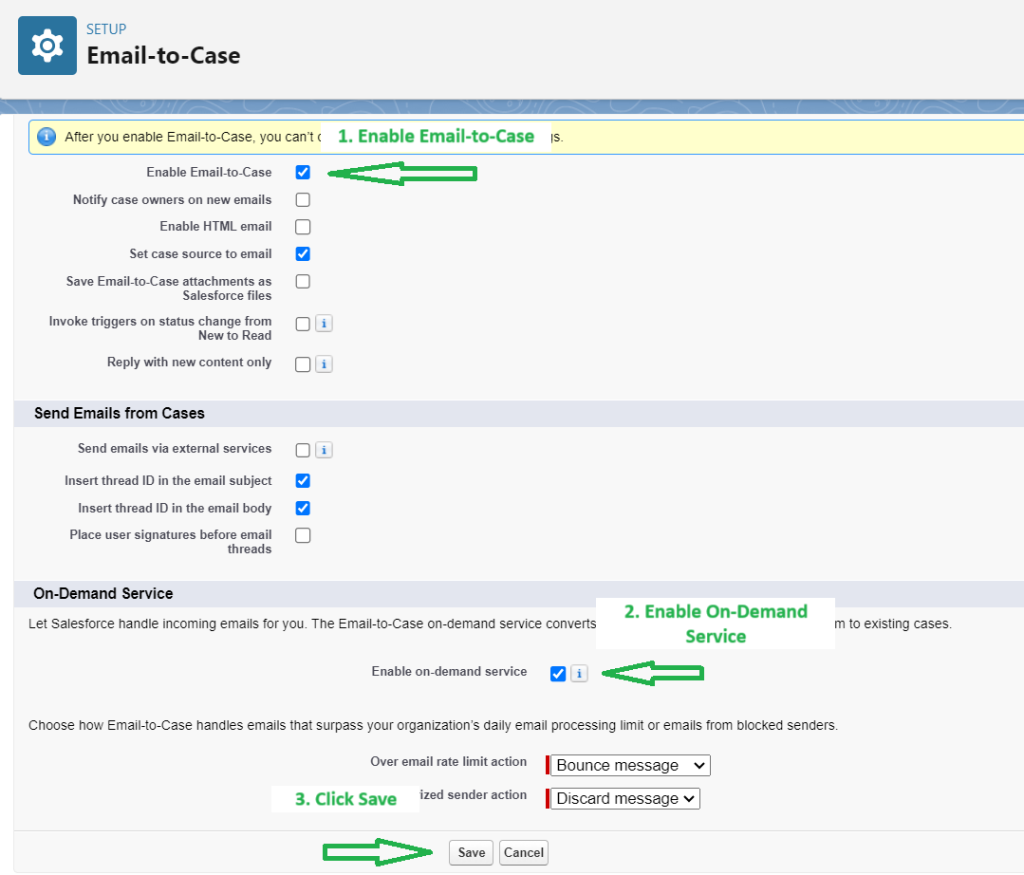
2. Next are the Routing Addresses for Email-to-Case
- Click on the “New” button from the Routing Addresses related list (at the bottom of the page)

- Define requirements:
- Set the Routing name for the Email-to-Case. The example used is “Exemplo Email To Case”
- Set the Email Address where the requests will be received. In this example the used email was “[email protected]”
- Check the “Save Email Headers” Checkbox in the Email Settings
- If you are the Owner, Under Case Settings, choose Queue in the Case Owner Dropdownlist and select the corresponding Queue.
If not, just select User in the Dropdownlist and Insert the User - Define the default case priority according to your needs. In this example we defined it as Medium
- Define the case origin. In this example we defined it as Email
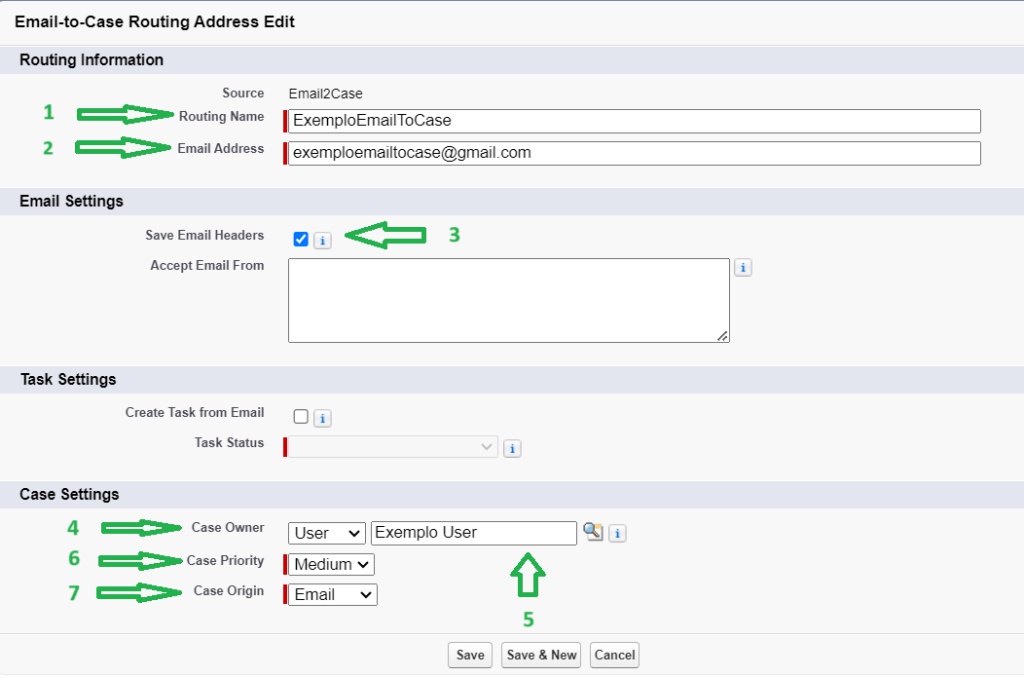
- Click Save
After Finishing, Salesforce will send you an email to your Email Address to verify the email ID
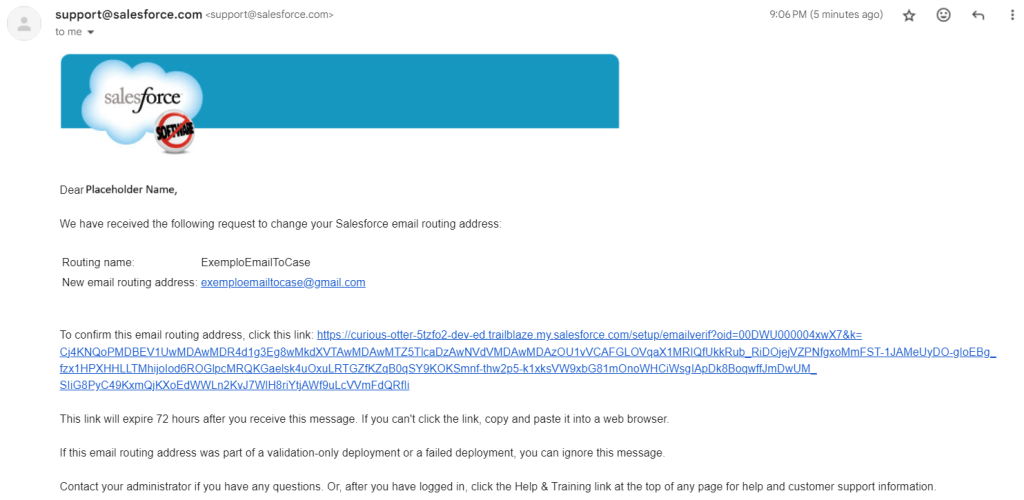
- Salesforce will automatically create an email id for you.
Copy the generated Email Services Address meanwhile.

Setup Routing on the Email Provider
3.1. Setting Up Routing/Forwarding Rules is the next step with Gmail
Now it is time to configure our email forwarding setting at our outlook, Gmail, or email provider.
- Configure your email system to forward messages received at [email protected] to auto-generated service addresses.
As we are using Gmail for the demo. User Gmail Article for Automatically forward Gmail messages to another account- In your Gmail, click on the settings icon, See all settings.
- Then Click on Forwarding and POP/IMAP tab.
- Then click on the “Add a forwarding address” button.
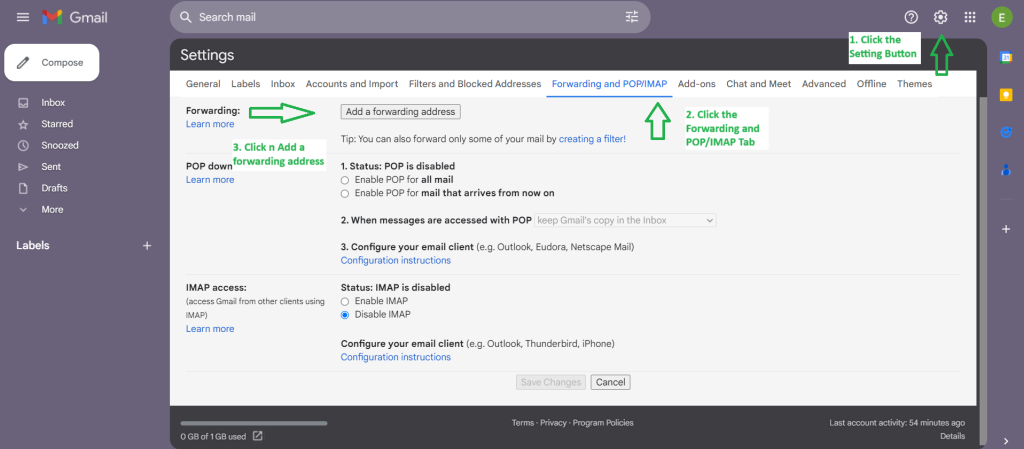
- Add forwarding address as the email provided by Salesforce.
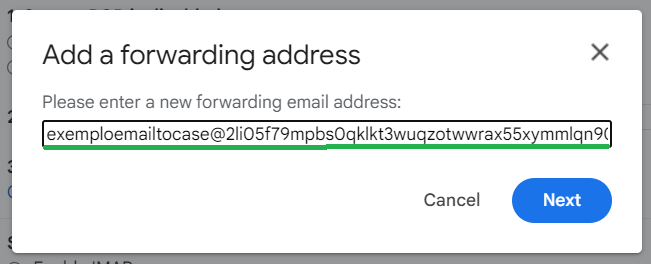
- With the email added, you will now see a Confirmation Screen saying forwarding email to auto-generated Salesforce email-to-case email ID.
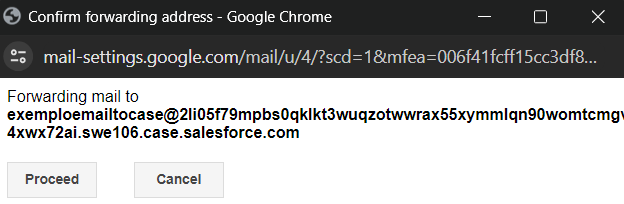
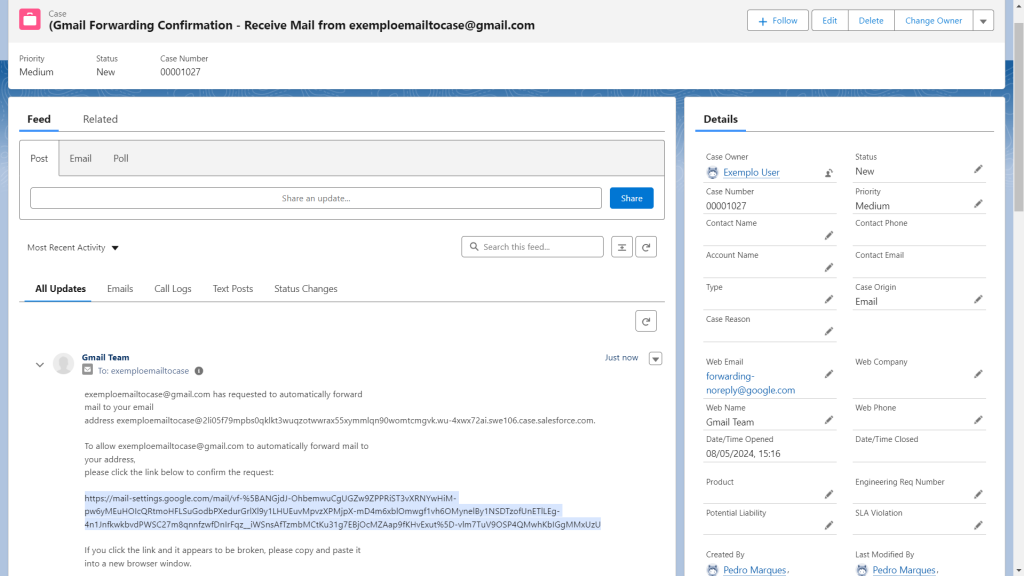
When you proceed, a new case will be created in Salesforce where you will have to open a link to confirm the forwarding email.
- Open the Salesforce case in Services and open the link. This means our email-to-case is working!
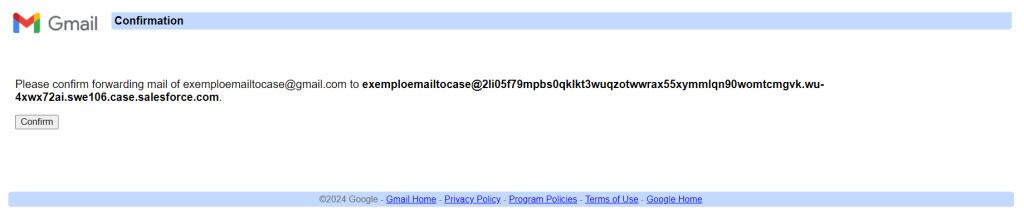
- After opening the link, click the confirm button to ensure the forwarding is set
- With this done, our last step is to go to the Gmail Settings again, and turn the forwarding on for the email we just confirmed, then click Save
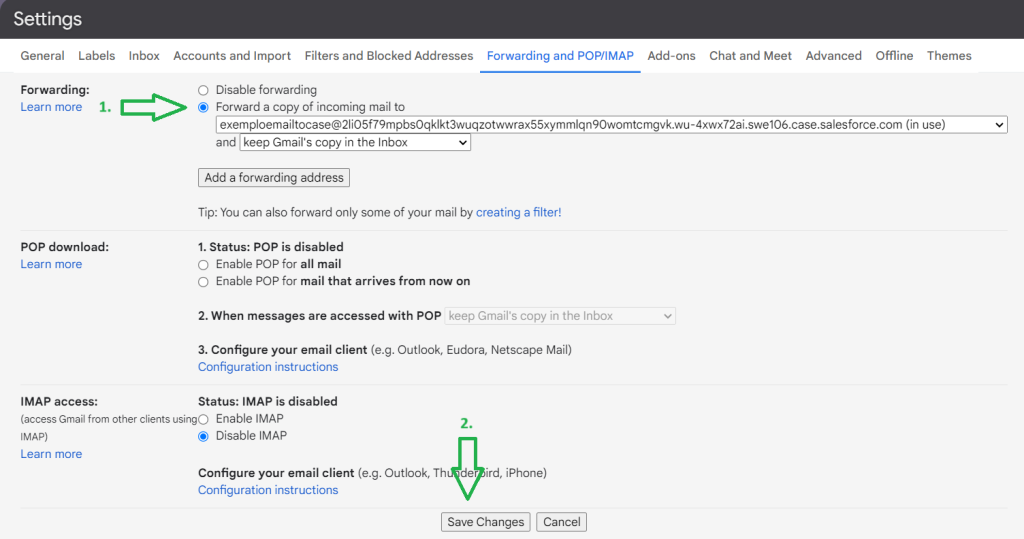
With this, we have concluded the Email-to-Case Setup using Gmail
3.2. Here we will show the steps for Outlook instead of Gmail
- Accept the request from Salesforce (an email is sent after creating and configuring email-to-case in salesforce)
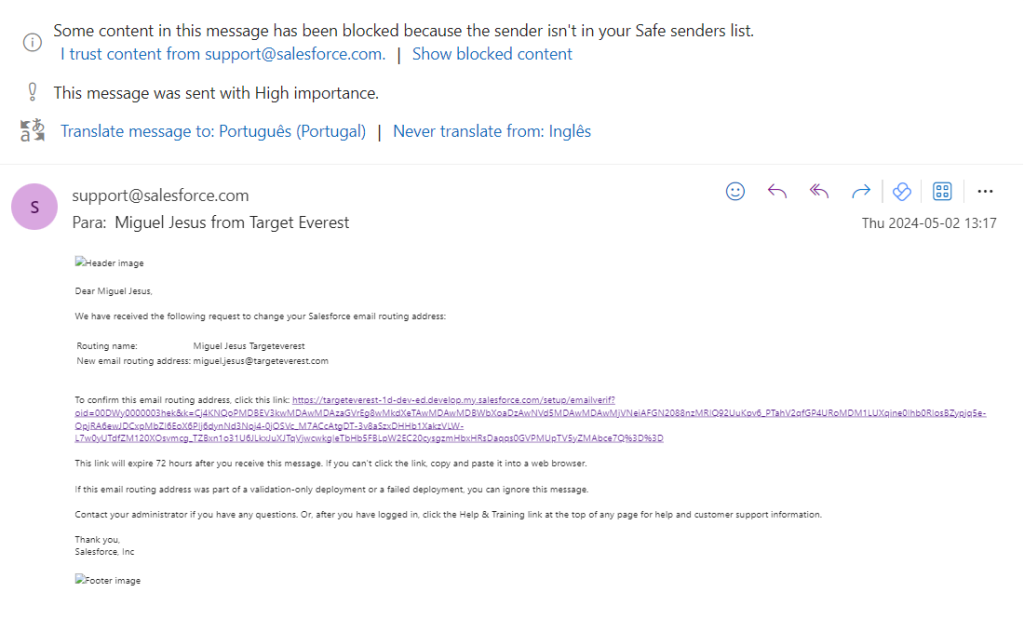
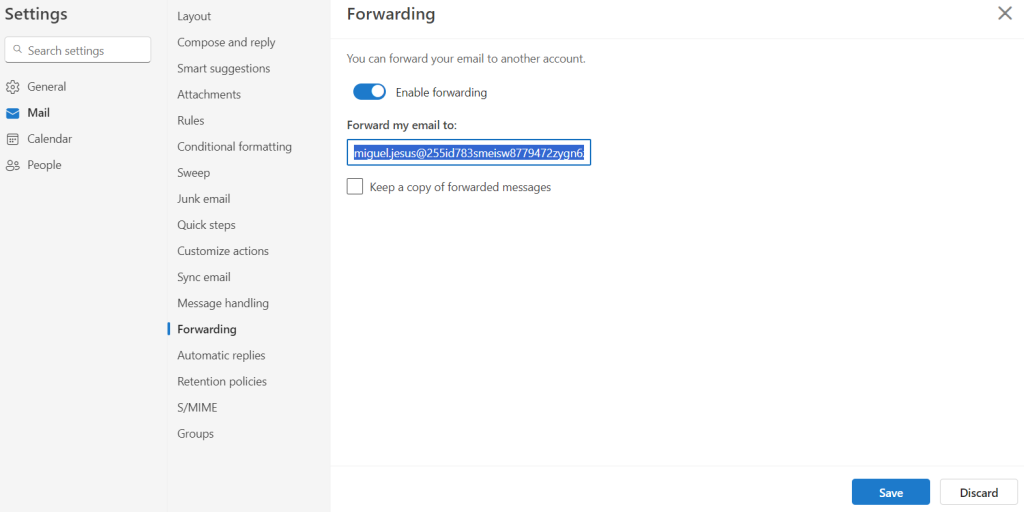
- Now we have to Define the forwarding rule
- Define criteria as needed for these configuration
- In action: Choose “Redirect to” and insert previously copied email
- Rule Name: SF Environment – Email-to-case – Account test
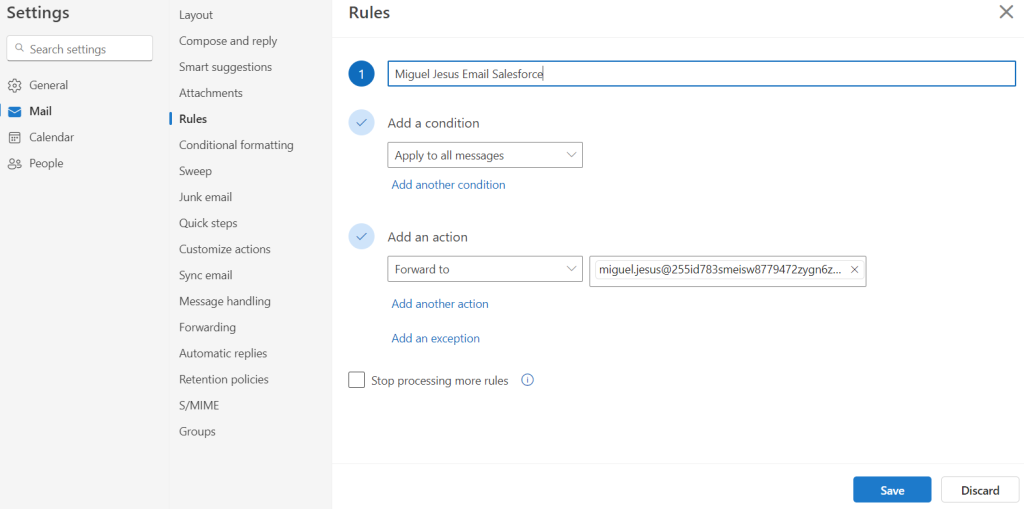
- (Ex: Forwarding Email – Email-to-Case – Account test)
Curious about Salesforce Email-to-Case? Fill out the form, and we’ll contact you shortly with more details!
Explore more articles on our blog!
Do you want to hear more?
Our team of experts specializes in Salesforce and is dedicated to providing top-notch services to help your business succeed. If you're looking for Salesforce® solutions or have any questions, please feel free to reach out to us. We'd love to hear from you.
Contact us