Guest 360º: The Difference Between Knowing a Booking and Knowing a Guest
 Target Everest |
 Everyone in hospitality talks about personalisation. Few hotels actually manage to deliver it. Only 23% of guests report a high level of personalisation after recent hotel stays, even though 61% of consumers would spend more for a tailored experience. The difference between the hotels that deliver and the ones that don’t has a name: Guest 360º.
What a Guest 360º is
A Guest 360º is not a bigger database. It is not more fields in the PMS. It is not merging marketing emails with reservations in an Excel spreadsheet.
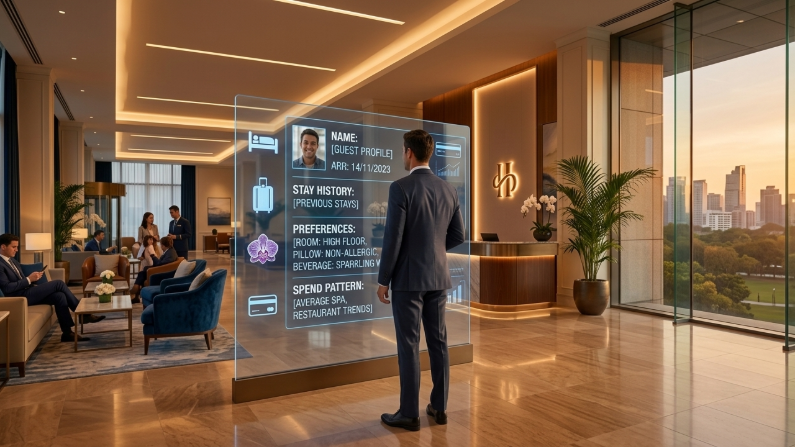
A Guest 360º is the ability, at any moment of the guest journey, to have a complete, up-to-date and actionable view of the relationship with that specific customer.
This includes:
- Stay history — when they stayed, at which hotel, in which room type.
- Consumption patterns — F&B, spa, experiences, additional services.
- Declared and inferred preferences — a high floor, a firm pillow, a recurring late check-out.
- Booking channel — direct booking, OTA, agency, corporate.
- Marketing interactions — what they opened, what they clicked, what they ignored.
- Value generated — not just the room rate, but the total value of the relationship. Industry benchmarks place average guest lifetime value between $2,000 and $5,000, rising above $10,000 in the luxury segment.
When this 360º view exists and is accessible to the right team, at the right moment, the hotel stops reacting to the guest and starts anticipating.
A reality we encounter in many projects
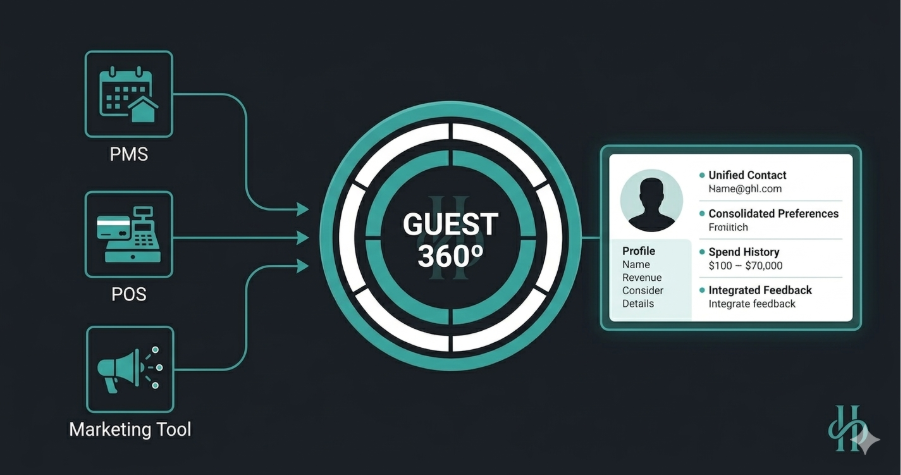
The existing systems do well what they were designed to do. The PMS manages inventory and reservations with precision. The POS records transactions in real time. Marketing automation platforms execute campaigns efficiently.
The problem does not lie in the individual performance of each system. It lies in the absence of an integration layer that unifies them. Each platform operates in silos, with its own data model and its own logic, with no visibility over what happens in the others.
The industry data confirms how widespread this is: nearly half of hotel professionals (49%) struggle to access the data they need for critical revenue and operational decisions, and 40% point to disconnected systems as their biggest obstacle.
The result is structural: none of these systems was architected to be the guest intelligence system.
Without a centralised data layer that consolidates, normalises and activates this information, the Guest 360º remains a concept with no real operational expression. We explored this architectural gap in more depth in Turning Data into Revenue in the Hospitality Industry.
When the Guest 360º works, what changes in practice
Three concrete scenarios.
Scenario 1 — Upselling before arrival. A guest who booked spa treatments during their last two stays has now reserved a standard room. With an active Guest 360º, the system identifies this pattern and automatically triggers a personalised communication before check-in, with a relevant offer at the right moment. The commercial upside is well documented: ancillary revenue from upsells already represents more than 18% of total hotel income on average, and guests spend around 20% more when offers are presented through digital self-service. Result: additional revenue with no commercial effort.
Scenario 2 — Retaining high-value customers. A corporate guest with 8 stays in the last 12 months has not booked for 3 months. Without integrated data, nobody notices. With a Guest 360º, this pattern of silence is detected and generates a commercial alert. The stakes are high: returning guests spend up to 67% more per stay than first-time visitors, and a 5% increase in retention can lift profitability by 25–95%. Result: a reactivation opportunity before the customer is lost for good.
Scenario 3 — Personalisation at check-in. The front desk welcomes the guest with real context: not just the name and the room type, but their preferences, their consumption history and an upgrade suggestion aligned with their profile. Done well, this kind of personalisation typically drives a 10–15% revenue uplift. Result: an experience perceived as premium, with no significant additional operational cost.
Guest 360º is not a technology project. It is a strategy project.
The technology is ready. Platforms such as Salesforce CRM are mature enterprise systems, with native architecture to support this Customer 360 model: end-to-end automation, integrated AI and real-time revenue intelligence. The stack exists. The platform maturity exists. We covered how this applies to hospitality in Salesforce for Hospitality: How Connected Guest Journeys Win in 2026.
What determines the success of an implementation is not the technology selected. It is the strategic clarity that precedes it.
- Which data do we want to capture, and at which point of the customer journey?
- How do we integrate the existing technology stack without replicating silos?
- Who is the data owner responsible for data governance and quality?
- How do we operationalise this intelligence in commercial processes, and who consumes it day to day?
The hotel organisations that structure these answers before starting the implementation are the ones that build a Guest 360º with real business impact — not just a systems architecture. Because in the end, the shift is the same one we described in Why RevPAR Is No Longer Enough: knowing a booking fills a room tonight. Knowing a guest builds value that compounds over time.
Sources
Do you want to hear more?
Our team of experts specializes in Salesforce and is dedicated to providing top-notch services to help your business succeed. If you're looking for Salesforce® solutions or have any questions, please feel free to reach out to us. We'd love to hear from you.
Contact us